Learn from the best!
Every week, I curate the viral videos overperforming across 40+ European radio stations. Join for free!

Every week, I curate the viral videos overperforming across 40+ European radio stations. Join for free!
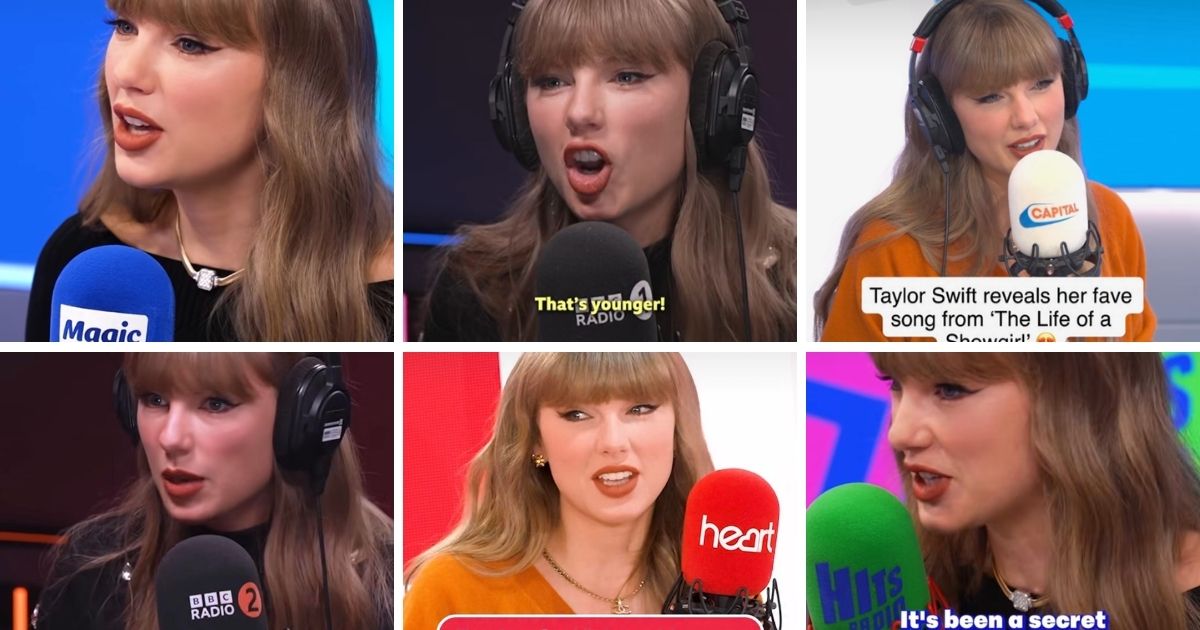
To celebrate the release of her new album The Life of a Showgirl, Taylor Swift partnered with six major UK radio stations — BBC Radio 1 and 2, Heart, Capital, Hits Radio and Magic FM — each airing an exclusive interview with the superstar, some even at the very same moment.
A flawlessly timed campaign that redefines how global artists can use radio in the age of social media.
A Taylor Swift album drop is always an event for music radio.
But having Taylor in the studio — that’s another story. She rarely appears in the media, and that scarcity makes the buzz even stronger.
That’s exactly what happened to six British stations:
Capital was the first to strike — dropping a sleek motion-design video on Thursday to announce Taylor’s arrival.
Greg James (BBC Radio 1), Hits and Magic went for humor instead.
At first, seeing all these simultaneous announcements, it felt like your classic global junket — every station getting its 5-minute Zoom slot. But then, Capital Breakfast’s co-host posted an Instagram Story showing Global’s headquarters literally barricaded for Taylor’s arrival.
She was clearly there in person.
Those authentic, off-the-cuff moments from presenters add something essential — a dose of humanity in an otherwise tightly controlled PR machine.
Humor works brilliantly to create connection, but for an event this big, it can feel a little too light.
That’s where a clean, official communication — clear, branded, instantly recognizable — helps restore a sense of occasion.
The sweet spot sits right between the two:
A simple visual (static or animated) clearly announcing date and time, paired with more spontaneous, playful behind-the-scenes content.
That “official + authentic” combo blends the brand’s credibility with the presenters’ personalities — keeping it warm and human, without slipping into over-polished territory.
Friday, October 3rd, 8 a.m. — four radio stations aired their Taylor Swift interviews, each running between 10 and 20 minutes.
But BBC Radio 1 quietly stole the show, posting its full interview on YouTube minutes before 8 a.m., even though the on-air broadcast wasn’t scheduled until the following Monday (Greg James, the host, was on vacation that week).
🕐 In short:
As soon as the interviews aired, every station broke them down into micro-clips — dozens of short social videos flooding Instagram, TikTok, YouTube, and X within hours.
With every media group now equipped with multi-camera studios, differentiation came down to editorial choices and tone.
Here’s what stood out:
💡 What could have taken it further:
A quick “behind-the-scenes” Reel or Story — Taylor settling in, chatting, laughing before the recording — would have added an extra layer of authenticity and proximity.
Simple, but powerful.
(Data collected on October 6)
Across platforms, Meta (Instagram + Facebook) dominated the Taylor Swift Game with a staggering 55 million views, compared to 15 million on TikTok and YouTube combined.
| Radio | Estimated Total Views | Top Platform |
|---|---|---|
| Capital FM | ~44 M | Instagram + Facebook |
| BBC Radio 1 | ~20 M | Instagram + Facebook |
| Hits Radio | ~10 M | Instagram + Facebook |
| Magic FM | ~6 M | YouTube |
➡️ Magic FM performed surprisingly well on YouTube despite having a smaller audience base.
(Capital) Why Opalite is Travis’s favorite song : 13M
(Capital) Her favorite track on the album: 10M
(Capital) They gift her bread : 9,5M
(BBCR1) Greg James’s wedding invitation : 9M
(Capital) Bed-rot : 6,8M
(BBCR1) Taylor’s Version vs. OG : 6M
(Heart) Baby Spice mention: 3M
(Hits Radio) The Riiiing : 2,9M
(Magic Radio) Favorite Lyric : 1,9M
(BBCR1) The sourdough gift : 1,9M
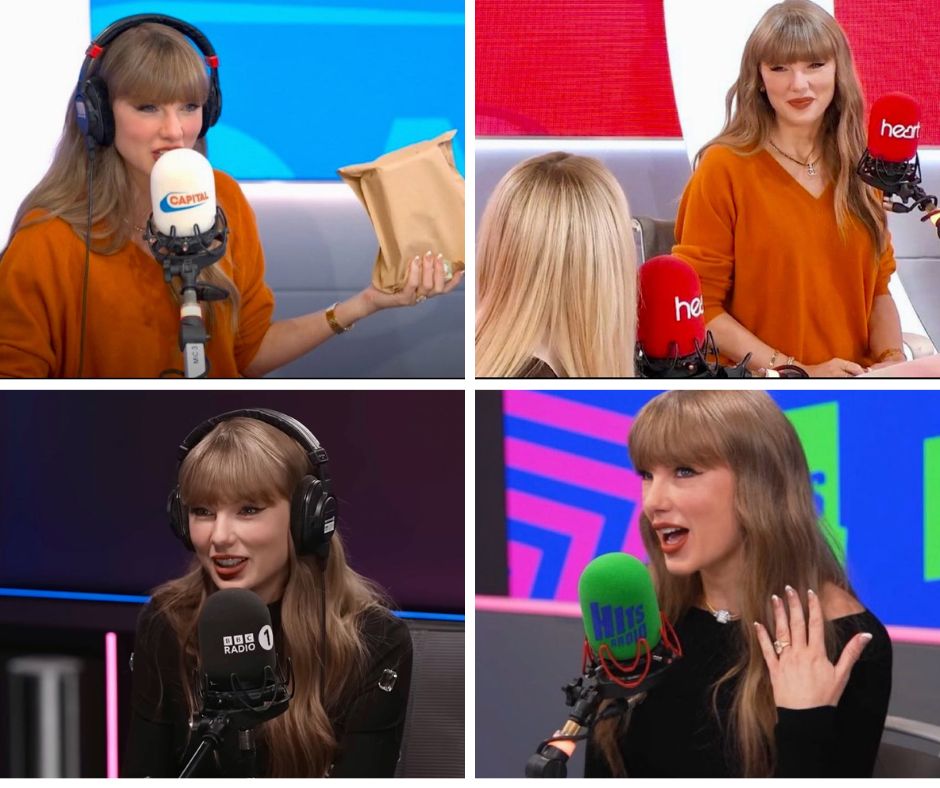
The BBC’s decision to publish its interview on YouTube before the on-air broadcast could have seemed risky — but in reality, it wasn’t.
If you’re a Taylor Swift fan, you’ll happily listen again on the radio for the context and the host commentary.
If you’re not, you’d have skipped the interview anyway.
Releasing early on YouTube meant joining the conversation while it was happening, without hurting the later radio audience.
Meanwhile, BBC Radio 2’s videos went live four days after the others — too late to ride the wave. Once the internet has moved on, even exclusives struggle to stand out.
Greg James was able to edit down his radio version to only the best moments, keeping it tighter and more accessible.
👉 Two timelines, two audiences:
A strong bridge between both could be a tease like:
“This Monday, we’re revealing everything that happened behind the scenes of the Taylor Swift interview.”
That way, whether you watch on YouTube, tune in live, or catch up on replay — you’re consuming BBC content.
Capital had a brilliant idea — a special episode of their podcast “After the Show, Show!”, where the hosts debriefed the behind-the-scenes of the Taylor Swift interview.
They shared details like: listening to the album on an old iPod to avoid leaks, songs being escorted by a security guard, random hallway anecdotes, Taylor’s height, and snippets that never made it on-air — including the moment she settled at the mic.
The “react” format is simple, fast to produce, and perfect to extend the on-air experience. It offers an original spin while staying close to the radio DNA.
Listeners who discover the podcast are naturally pushed to tune into the live show — and vice versa.
On air, the hosts positioned the podcast as a “can’t-miss extra moment”, which strengthened the bond between station and audience by promising transparency and intimacy.
Greg James (BBC Radio 1) did something similar: short “react” segments aired after the main interview.
Again, a smart way to add context and keep the conversation alive a bit longer.
Radio remains a powerful medium, especially in the morning — every segment can instantly become a social media asset.
In just an hour and a half of cumulative interviews, Taylor appeared on six UK stations, reached around 15 million live listeners, and generated over 90 million social views.
The result: Taylor nailed her comms strategy — and radio won too.
She proved that, even in the social-media era, radio remains a key touchpoint for global artists — a medium that drives emotion, conversation, and massive online reach.
The only downside?
True to form, Taylor won’t do the same thing twice. She’ll find another way to surprise us next time.
Your station’s social media presence shapes how people see, find, and remember you.But if you want it to truly serve your on-air brand, stop treating it like a reflex.Think of it instead as an editorial extension — a space that amplifies what makes your station unique. Here are 15 simple, practical ways to turn your…
TikTok and iHeartMedia have just announced a major multi-platform partnership. Together, the two companies will launch a complete ecosystem combining filmed podcasts, radio, video studios and live events. The agreement marks a strategic turning point: TikTok creators will become voices and storytellers at events, on radio and in podcasts. The “TikTok Podcast Network”: 25 new…
Global announces the acquisition of a majority stake in The Overlap, the sports media company founded in 2021 by Gary Neville. The aim is to accelerate the creation of a network of video-first sports brands with football as their central pillar. Who are they? On the one hand, we have the Global group, the leading…
Bauer is now replacing a large proportion of its traffic bulletins on Greatest Hits Radio and Hits Radio with updates generated and read by AI. The group worked with INRIX, its long-standing partner for traffic data, to switch to an automated system. Practical changes The majority of traffic reports are no longer recorded by humans….
The BBC has announced another record year for its BBC Sounds platform. Between January and November 2025, the audio platform exceeded 2.5 billion listens, an increase of +8% compared to the same period in 2024. A total of 2.8 billion audio plays were recorded across the BBC ecosystem, including radio, podcasts, sport, news and rich…
The 27th edition of the NRJ Music Awards, broadcast live from the Palais des Festivals in Cannes on 31 October, once again confirmed its status as a major music event on social media. Seven days after the broadcast, the ceremony hosted by Nikos Aliagas attracted 3 million TV viewers, dominating key audiences: But the biggest…