How BBC Radio 4 adapts its shows for social media to reach a new audience ?
Long perceived as the soft-spoken voice of the British establishment, BBC Radio 4 has been quietly but deliberately shifting its strategy over the past few years. Across Instagram, Facebook, X (formerly Twitter) and, more recently, TikTok, the station is now multiplying short formats, humorous clips and debate extracts to reach a younger, more mobile audience.
Within the BBC ecosystem, this social media repositioning addresses a central challenge: keeping a spoken-word brand visible and relevant in an attention economy dominated by platforms. While Radio 1 or BBC News are expected to perform on social networks, Radio 4 much less so. And yet, its content is gradually finding its place there.
With what objectives, what tools and what early results? Here’s how BBC Radio 4 is adapting its programmes to social platforms to remain visible, listened to and shared.
1. BBC Radio 4: a historic pillar facing the challenge of renewalent
Launched in 1967, BBC Radio 4 is the BBC’s flagship generalist talk station. It broadcasts daily news programmes (Today, PM), debates, documentaries, cultural shows and fiction (The Archers, Front Row). It is also one of the few remaining stations still commissioning original radio drama.
In 2025, Radio 4 reaches around 8 million weekly listeners, making it the BBC’s second-largest station after Radio 2, according to RAJAR data. But this audience is ageing, with an average listener age of around 60. Some flagship programmes have also declined over time: The Today Programme, for example, dropped from 7.5 million listeners in 2016 to 5.8 million in 2023.
At the same time, on-demand listening has exploded. Through BBC Sounds, the group’s audio streaming platform, Radio 4 has reached new audiences, particularly via exclusive podcasts. By Q3 2025, 8 of the 10 most listened-to podcasts on BBC Sounds were Radio 4 productions. The BBC now considers the decline in linear listening largely offset by this shift to on-demand consumption.
One blind spot remained: social media. Since 2022–2023, that has started to change. Radio 4 has significantly increased the number of video clips and native formats designed for TikTok, Instagram and X. The goal is clear: gain visibility among 25–45 year-olds by repackaging its programmes in a more accessible way.
2. A clear strategy: making BBC Radio 4 visible where attention lives
Since 2020, the BBC has accelerated its presence on social platforms with a clear priority: reach younger, more volatile audiences where they already are. This strategic shift applies to the whole group, but Radio 4 represents a special case. Long, spoken formats had to be adapted to visual, fast-paced, engagement-driven environments.
A group-wide direction: more video, more social
As early as 2020, Charlotte Moore, BBC Chief Content Officer, stated that the group needed to “rethink the distribution of its programmes for younger audiences” and invest more heavily in third-party platforms. Ofcom later confirmed this direction, noting that the BBC was increasingly producing platform-specific content for TikTok, Instagram and YouTube, with the aim of “boosting brand awareness and driving audiences back to BBC Sounds. .
A late arrival for Radio 4
Until 2022, Radio 4’s social presence was largely limited to Facebook (1.6 million followers) and Twitter (around 500k). Its Instagram strategy only became structured from 2022 onwards, and the TikTok account @bbcradio4 was launched as late as September 2025, via an introductory video also shared on Instagram and Facebook:
“Hello TikTok! From thought-provoking debates to unforgettable and hilarious moments, BBC Radio 4 has always been about great storytelling. Now we’re bringing some of it to TikTok.”
Radio 4 joined TikTok well after other BBC brands such as Radio 1 or BBC News. No official explanation has been given for this delay. I contacted the BBC teams to ask whether there was a specific strategy behind this timing.
Objectives: awareness, accessibility and traffic to BBC Sounds
Radio 4’s social media strategy focuses on three main goals:
• Improve brand perception: challenge the “dusty” image among under-40s and show that Radio 4 can also be funny, surprising and accessible.
• Create engagement around programmes: through extracts, anecdotes, behind-the-scenes content and visuals.
• Drive on-demand listening: every social clip points, directly or indirectly, to BBC Sounds or programme replays.
The station is not chasing virality at all costs. Unlike shock formats or fleeting trends, it prioritises editorial consistency with its identity, even on TikTok or Instagram. This approach reflects a broader BBC philosophy. As Ofcom noted in its 2022–23 report:
“We observed that the BBC’s content on third-party platforms is increasingly designed to reflect its public service values, not just chase reach.”
The BBC has also professionalised its workflow. BBC Radio 4 relies on a dedicated social media team linked to BBC Sounds, responsible for adapting radio content for digital platforms. Working closely with programme producers, this team selects usable moments, edits them into short video formats, and distributes them across TikTok, Instagram, X and Facebook, always pointing back to BBC Sounds.
BBC Radio 4 and the art of editing
Adapting spoken-word formats, often long or complex, to the visual and concise codes of social media is a structural challenge for all radio brands. Over the past two years, Radio 4 has systematised repurposing: turning linear broadcasts or podcasts into engaging social clips.
Short, clear, contextualised extracts
Videos published on Radio 4’s TikTok, Instagram and Facebook accounts almost always reuse existing audio: interviews, humorous moments, strong reflections or unexpected exchanges. They are re-edited in vertical format (9:16), dynamically subtitled, and framed with a simple, explicit title (“What is envy, really?”, “This is why you can’t sleep”, etc.). The programme name is often displayed discreetly, without dominating the frame.
Most clips last between 30 seconds and 2 minutes.
An implicit editorial filter
Radio 4 does not publish everything it broadcasts. The chosen extracts clearly follow recurring editorial criteria:
• Immediate clarity: the clip must work on its own, without a long introduction.
• Emotional or intellectual hook: surprise, humour, contradiction or a strong insight.
• Personal resonance: themes such as parenting, mental health or generational conflict.
These principles are visible not only in the content itself, but also in BBC job descriptions, which emphasise the ability to identify “engaging and accessible radio moments”.
From clip back to the original format?
What works particularly well is that, whether the source is linear radio or a podcast original, everything looks stylistically coherent (strong visual identity helps here). Microphones are always visible and central, reinforcing the feeling that this is radio, whatever the format.
While most social content still comes from broadcast programmes, Radio 4 also experiments with social-only capsules: studio reactions, behind-the-scenes moments, or re-performed quotes.
The clips that performed best this season
I’ve organised the strongest performers by programme to give you a clear overview of what works. Notably, many extracts from I’m Sorry, I Haven’t a Clue significantly overperform on the account.
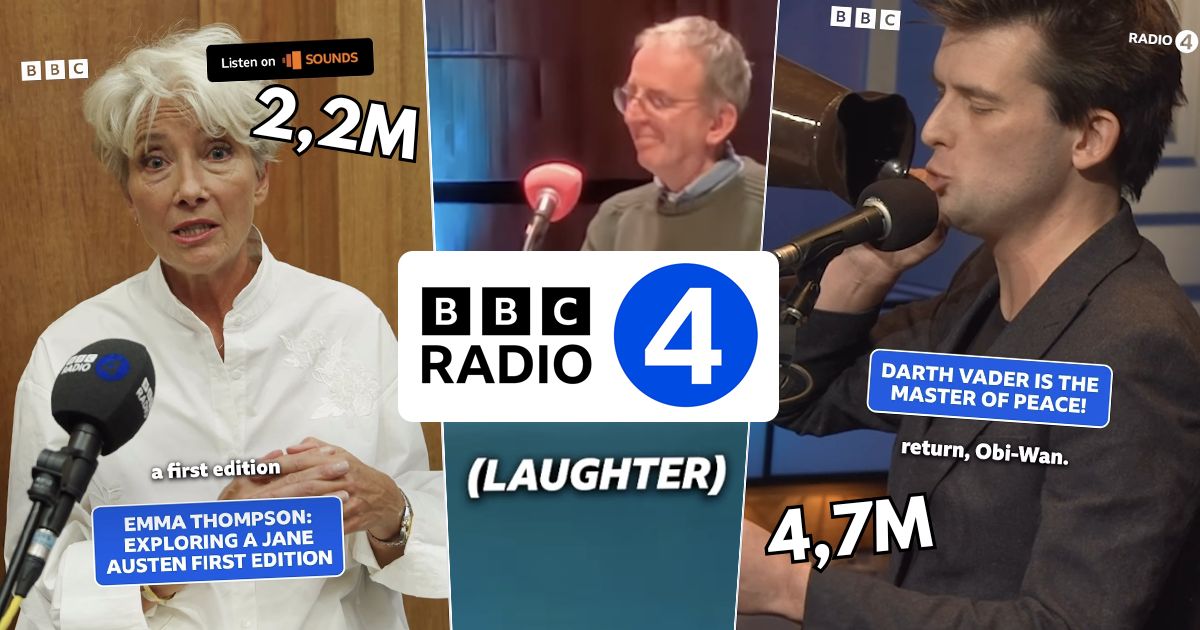
1. Dead Ringers : This show takes first place with a special clip celebrating its 25th anniversary: a sketch featuring Darth Vader (as Donald Trump) receiving a FIFA peace prize. 110 339 interactions.
Why it works: a cult programme celebrating a milestone, featuring a popular Instagram creator. The clip is topical, absurd and immediately funny.
2. I’m Sorry I Haven’t a Clue : The flagship comedy show reached 101,465 interactions with a clip about phrases you can say “in the bedroom or in a traffic jam”.
Why it works: this is BBC humour at its purest. The contrast between very British wordplay and deliberately old-fashioned staging perfectly embodies a certain timeless, absurd, deadpan British spirit.
3. Book Club : A special episode with actress Emma Thompson answering questions about Jane Austen generated 87,681 interactions.
Why it works: Thompson speaks with genuine tenderness about a book that clearly matters deeply to her.
4. Young Again : A powerful moment where trauma specialist Gabor Maté looks at photos of himself and addresses his younger self.
85,436 interactions.
Why it works: the music, the gravelly voice and the poetic tone create a deeply emotional moment.
5. Strong Message Here : A widely discussed segment on the appropriation of Tolkien by the far right. 67,620 interactions.
Why it works: intense debate in the comments section, driven by a highly polarising topic.
6. The Adverb : A performance by poet misspunnypennie at the Hay Festival reached 42,555 interactions.
Why it works: the poet has a strong Instagram following, and the opening line “you are here” immediately stops the scroll.
BBC Radio 4’s rise on social media marks a clear strategic shift. In just a few months, the station has structured its TikTok presence, professionalised its content repurposing, and found a tone that allows it to exist in social feeds without betraying its identity.
The results are not yet measured in millions of followers, but in visible signs of adaptation: well-crafted clips, genuine engagement, frequent reuse by other accounts, and a slowly evolving image among younger audiences. For a brand long perceived as elitist and ageing, being commented on, shared or remixed on TikTok already represents a symbolic shift.
The real challenge now is conversion: turning social visibility into listening on BBC Sounds.